
Products


Can Fresh Aluminum Beer Cans - 500ml/16.9 oz. (Case of 207)
Case of 207 aluminum cans and lids. Cans are 16.9 oz (500 ml). 202 end diameter beverage cans with B64 lids. These cans are made with a BPA free liner. Please note that up to 5% of the cans are likely to be dented or damaged in transit.
$143.00


Can Fresh Aluminum Beer Cans w/ Full Aperture Lids - 500ml/16.9 oz. (Case of 207)
Case of 207 aluminum cans and lids. Cans are 16.9 oz (500 ml). 202 end diameter beverage cans with Full Aperture lids that are fully compatible with the B64 sealing rollers featured on the Cannular can seamer. These cans are made with a BPA free liner. Please note that up to 5% of the cans are likely to be dented or damaged in transit.
$154.00

Candi Syrup - 180 SRM
This is a premium extra dark Belgian style candi syrup. It has the unmistakable flavors of rich toffee, dark stone fruit, and toasted bread. This candi syrup is the basis for the perfect cloning of Westvleteren 12, Rochefort 10, and many other dark Belgian Ales. When you consider brewing specialty ales like these, consider the more authentic end result, superior flavor, darker color, and exceptional results offered by this candi syrup. CONTENTS: HIGH FRUCTOSE CORN SYRUP, CARAMELIZED SUGAR SYRUP, CARAMEL SRM: 180 PPG: 1.032 1 pound
$6.99

Candi Syrup - 240 SRM
An extra dark candi syrup with strong notes of raisin, black currant, and roasted caramel. A superior syrup for all dark ales. CONTENTS: HIGH FRUCTOSE CORN SYRUP, CARAMELIZED SUGAR SYRUP, CARAMEL SRM: 240 PPG: 1.032 1 pound
$6.99

Candi Syrup - 45 SRM
This candi syrup is translucent amber in color with notes of toffee, vanilla, and toasted flavors. Exceedingly good in Brown Ales or medium Golden Ale's that require an aromatic nose and subtle flavor. CONTENTS: HIGH FRUCTOSE CORN SYRUP, CARAMELIZED SUGAR SYRUP, CARAMEL SRM: 45 PPG: 1.032
$6.99

Candi Syrup - 90 SRM
This candi syrup creates an unmistakable pallet of subtle toffee, and toasted bread flavors that make a dark candi syrup truly brew-worthy. This syrup will ensure the caramel aroma and rich flavors of award winning Belgian style ales. CONTENTS: HIGH FRUCTOSE CORN SYRUP, CARMELIZED SUGAR, CARAMEL LOVIBOND: 90 PPG: 1.032 1 pound
$6.99

Candi Syrup - D-240
D-240 Candi Syrup is the richest and darkest candi syrup available on the market. Created to have a rich smooth palate, D-240 is a triple-dark syrup with hints of dark raisin, extra dark stone fruit and a roasted dark caramel back-palate. For ales that require full body and indescribable flavor that will set your ales apart.Contents: Beet sugar, Date sugar, water.Specifications: SRM - 240º L, PPG - 1.0322.5 LB Container
$19.99

Capillary Tubes
Replacement capillary tubes for chromatography kits. 100 tubes in a pack.
$14.99


Caramel Steam Malt - 55 pound bag
Caramel Steam malt is created via an innovative process that develops crystal characteristics and a rich, nutty flavor. Caramel Steam can be used as a direct substitution to crystal malts for those desiring crystal-like flavors, but wanting a softer sensory impact. Specifications: Color °L : 35 - 45 Moisture % : 5 Protein Total % : 12 Max Usage Rate % : 20 55 pound bags of grain are excluded from flat rate / free shipping offers. Also available by the pound.
$78.00

Carb Stone
If you didn't already know the Spike Conical is a unitank! This means it is designed to handle pressures up to 15psi. This capability allows you to add 15psi of pressure needed to carbonate your beer before transferring to your keg. This will reduce carbonation times from upwards of a week down to less than 24hrs. Spike Brewing's carb stone is designed to attach to the outside of the racking port butterfly valve. This means the carb stone can be installed when you need it and won't be sitting inside the tank during the entire fermentation process. This eliminates the chance for the stone to become clogged. It also has a protective stainless housing which prevents damaging the very brittle 'stone'. Detailed product guide:Product Guide.pdf Forced carbonation pressure chart:Carbonation Chart Carb Stone Only Carb Stone 1.5" TC Clamp 1.5" TC Gasket Gas Post Carb Stone Bundle Carb Stone Package (see above) Pressure Gauge (Link) PRV (Link) 2nd Gas Post (Link) Gas Manifold (Link) **Always use a 15psi pressure relief valve when pressurizing a tank**
$85.00 - $160.00


Carbonation Ball Lock Quick Disconnect (QD) Cap Tee Fitting
Make a really small and useful keg system out of PET plastic bottles. Great for taking beer to a party or making your own micro/portable/mini keg system. PCO 1881 threading on all ends. Tee fitting only. Does not include Carbonation Caps or PET growler.
$4.40
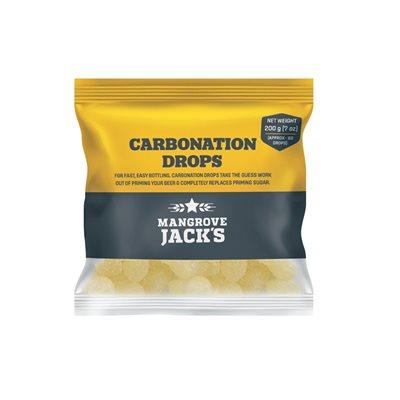
Carbonation Drops - Mangrove Jack's
For fast, easy bottling. Carbonation Drops take the guess work out of priming your beer and completely replaces priming sugar. Perfect for bottle conditioning. 60 drops per bag.
$8.99

Carbonation Keg Lid
A corny keg lid with an extra gas post which connects to a .5 micron stone. Simply connect your gas quick disconnect to the included fitting on the lid and allow carbonation to begin. How to use this product:Beer must be stored cold 34–40°F1. Preboil the stone for 2–3 minutes before using. This assures you that your stone is sterile and any residual oils have been boiled off.2. Sanitize the whole keg lid before submersing into your keg filled with beer.3. Set your PSI on your regulator to 3–4psi and attach your gas in fitting to the body connect on the lid. Leave keg at this pressure for 1 hour.4. Raise your pressure 2PSI per hour until you reach 10–12psi. Leave it at 10–12psi for 24 hours. Pour a pint and test the carbonation. If you think your beer needs more CO2 leave for another 4–6 hours and have another pint.5. Remove carbonation lid after carbonation level is satisfactory. Return original keg lid for long term storage.
$66.00

Carbonator Reactor Carbonation Keg Lid
Nothing is more refreshing that having your own soda water on tap at home. SodaStream units are great but filling up those tiny 1L bottles is a pain and those small CO2 cylinders run out fast and are expensive to swap. Solve this problem once and for all with the Continuous Soda Carbonator Keg Reactor Solution. KegLand has invented this really easy-to-use keg lid that attaches to a standard ball lock keg. Setup: Position the keg inside your fridge or kegerator (ideally below 40°F). Attach your beverage draft line to the soda water out post. Attach your gas line to the gas-in post. Set your CO2 regulator to 30-50 psi, depending on how highly carbonated you like your soda water. We highly recommend using a check valve on your CO2 line. On first use, purge the air from the headspace of the keg. Connect the mains water to the water inlet post on the lid of the keg. It is recommend to also use a check valve on your mains water line to prevent soda water from going back into your house mains. Depending on your mains water pressure, you may need to reduce it using the Duotight In-Line Regulator. For the Carbonator Keg Lid to work well, the mains water pressure should be 30-40 psi higher than your regulator set pressure (from Step 4). That's it. This simple unit will give you continuous soda water connected to your mains water.
$77.00

Carboy Brush - Nylon Coated
This carboy brush is the perfect product for cleaning the neck and bottom of all carboys. Tough with debris, and friendly with your PET - this carboy brush is made from stainless steel and the wire is coated to protect against damage to glass and PET carboys. It is made out of FOOD GRADE Nylon and Stainless Steel. Long enough to reach all angles. Once you use this innovative “L” carboy brush, you won’t want to use the old straight carboy brushes anymore. Bristles are made of Nylon, Food grade material and BPA free. Coated wire protects the PET carboys and FerMonsters™ from scratches also protects Glass Carboy necks. Maximum Temperature: 140 °F (60 °C) Dimensions: Height from end of handle to 90 degree bend = 21.5” Brush section at the bottom is 8.5” long. Bristles are 2-3/4” in diameter.
$8.99


Carboy Cap - 6.5 Gallon
Carboy cap for 6.5 gallon glass threaded style carboys.
$3.99

Carboy Drainer
Holds carboys upside down to drain & dry.
$9.99

Carboy Handle for 3 - 6 gallon carboys
The Metal Carboy Handles, will allow you to get-a-grip when washing and sanitizing your glass carboys. As it is rubberized, vinyl coating makes it easy for wet hands to hold. Very handy when dealing with soapy glass or keeping carboys steady when moving them. It fits securely underneath the lip of the carboy and tightens down with the simple turning of a wing-nut. The Orange Carboy Handle will work with either 3, 5 and 6 gallon Glass carboys. Not meant for carrying full carboys. Instructions: Remove or loosen the wingnut and then place clamp over the top of carboy neck and press down until it sits on the inner ring of the neck. Reassemble clamp unit and handle through the screw and the washer and tighten the wingnuts. Tighten the wingnut until feels tight enough (Do Not Overtighten). Warning: Carboy handles are only meant to carry empty carboys. If you must move a full carboy with a Carboy Handle, support the underneath with your hand.
$7.99

Cascade Cryo Hops LupuLN2 Pellets
Cascade CryoHops LupuLN2 Pellets Aroma Specification: fruity, citrusy, herbal Alpha-acids: 9.5-10.5% Total oils: 1.0-2.0 Note: Repacked in oxygen barrier packaged and nitrogen flushed to preserve freshness.DESCRIPTIONLupuLN2 hop powder and pellets are produced from whole leaf hops using YCH HOPS™ proprietary cryogenic separation process that preserves all components of each fraction.LupuLN2 is purified lupulin powder containing most of the resin compounds and aromatic oils derived directly from whole hop flowers. It is ideal for use in the whirlpool or fermenter for imparting intense hop flavor and aroma with minimal vegetal flavor and improved yield. Used in combination with Resinate® CO2 extract, LupuLN2 can add hop aroma and flavor to the end of boil or in dry hopping for a twofold approach to achieving superior brewery efficiency without sacrificing flavor. Depending on how much pellet or whole leaf is replaced by either of these products, breweries may see significant improvements in beer yield which contribute to both the bottom line and sustainability mission of YCH and many of our customers.APPLICATION AND USAGELupuLN2 may be used anywhere pellet hops can be used and are best used for late kettle and dry hop additions. As a starting point for recipe formulation or modification dose rate is estimated at 50% of pelletsby weight. It is best used in beers defined by their hop flavor and aroma with hop loads of at least 1 lb/bbl in late kettle or dry hop additions where a largeryield increase will occur from substituting out pellets or whole leaf.PACKAGINGLupuLN2 is packaged inside nitrogen flushed, flexible, foil pouches and shipped in cardboard cartons.STORAGELupuLN2 should be stored near-freezing, preferably between 30°F and 41°F (-1°C and 5°C). For best results, LupuLN2 should be used within three (3) years of package date. Storage stability does vary per variety and can be negatively affected by exposure to oxygen, heat and/or light.
$4.20 - $41.60

Cascade Honey Ale Extract Kit
Get ready to experience the perfect balance of a crisp light body, floral hops, and honey notes in this Cascade Honey Ale Extract Kit. With no steeping grains, this recipe makes for a quick and easy brew day, resulting in a thirst-quenching beer that will satisfy all your senses. Each kit includes high-quality malt extract, specialty grains, and hops. With step-by-step instructions included, you'll be guided through the brewing process, ensuring a smooth and successful batch every time. Our recipe kits include steeping muslin socks for grain and boiling hop additions. Yeast and priming sugar are not included in the kit and are optional add-on items. Estimated Beer Stats LME Option DME Option Original Gravity (OG) 1.053 1.050 Final Gravity (FG) 1.010 1.010 Approximate ABV 5.6% 5.3% Color (SRM) 3 2 Bitterness (IBUs) 28 29 Ingredient / Instruction Sheet *YEAST SOLD SEPARATELY* Makes 5 Gallons
$39.99 - $42.99

Cascade Pellet Hops
A dual purpose American hop with an alpha acid percentage ranging from 4.5-7%. The flavor and aroma are famously citrus-like (particularly ruby red grapefruit) with prominent floral tones. Cascade is the classic finishing hop for pale ales, IPAs, stouts, blonde ales, and wheat ales. Similar varieties include Centennial and CTZ. All hops are nitrogen flushed during packaging including any repackaged in-house.
$1.95 - $17.00

Cascade Rhizome
Grow your own hops with a rhizome root stock. Cascade hops are a dual purpose American hop with an alpha acid percentage ranging from 4.5-7%. The flavor and aroma are famously citrus-like (particularly ruby red grapefruit) with prominent floral tones. Cascade is the classic finishing hop for pale ales, IPAs, stouts, blonde ales, and wheat ales. Cascade hops are one of the recommended hops for beginner growers. The other recommended hops for beginners are Magnum and Nugget.
$7.00

Cashmere Pellet Hops
Cashmere is a dual-purpose hop that offers delicate aromas of lemon and lime with secondary notes of lemongrass and tangerine. Aroma and Flavor profile includes citrus - strawberry, melon, berries, stone fruit, herbal, spicy, tropical, woody. Alpha Acid: 6.0 - 9.0% Beta Acid: 4.0 -7.0% Total Oil: 0.5 - 1.8 ml/100g All hops are nitrogen flushed to preserve freshness.
$2.00 - $19.45
-
Cashmere Rhizome
Grow your own hops with a rhizome root stock. Cashmere is a cross between Cascade and Northern Brewer released by Washington State University in 2013. It is a dual-purpose stunner evoking melon, tangerine, and other tropical and spicy notes alongside smooth bitterness. Aroma and Flavor profile includes Fruit, Tropical/Fruit, Spicy Typical Ranges Alpha Acid: 6.9 - 10.1 % Beta Acid: 3.5 - 7.1 % Total Oil: 0.5 - 1.8 ml/100g
$6.00


Caster Kits
The Spike Brewing casters screw directly into the bottom of their conical legs for easy installation. The CF5, 10 and 15 use a 3" caster while the CF30 uses a larger 4" caster. CF5, CF10, CF15 Specifications: 3" caster wheel Set of 3 Non-marking wheel Locking brake + locking swivel CF30 Specifications: 4" caster wheel Set of 4 Non-marking wheel Locking brake + locking swivel *Spike Brewing recommends a standard or extended bracing shelf when using the casters for added stability* Caster wheel install and instructions:Install + instructions
$40.00 - $63.00

CBC-1 Cask and Bottle Conditioned Beer Yeast
CBC-1 has been especially selected for it's refermentation properties and is recommended for Cask and Bottle Conditioning. CBC-1 referments beers up to 12-14% ABV due to its high resistance to alcohol and pressure; it does not produce flavors therefore conserving the original character of the beer. The yeast will settle and form a tight mat at the end of refermentation. CBC-1 can also be used for primary fermentation and is especially suitable for Champagne-like beers and fruit beers. CBC-1 will ferment and referment within a range of temperature from 15° to 25°C (59° to 77°F). This particular strain has also been extensively tested for high gravity brewing to produce flavored-alcohol beverages.
$5.99

CellarScience® Acid Test Kit
Used to determine the Total Acidity in a wine, the CellarScience Acid Test Kit is an invaluable tool for any home winemaker. Total Acidity measurements are important to winemaking because the correct amount of acidity is key to maintaining a wine which is balanced in flavor and stable for ageing.Kit Contents: Large Reaction Vial 10mL Syringe 4oz of Sodium Hydroxide Reagent Phenolphthalein Indicator in 1oz Dropper Jar Reagent Stability Information: Sodium Hydroxide Solution - 0.1 Normal (2 year shelf life cool & closed, 3 month shelf life cool and opened) Phenolphthalein Indicator - 1.0% (5 year + Shelf life) Ships via ground transportation only.
$12.99

CellarScience® ALDC 1 oz. | Diacetyl Reducing Enzyme
Reduce Diacetyl production during fermentation or dry hopping with ALDC from CellarScience. ALDC, or alpha acetolactate decarboxylase, is a helpful enzyme that can be added at yeast pitching or along with your dry hops to limit the production of Diacetyl to protect your finished beer from off-flavors and reduce the conditioning time needed before its ready to bottle or keg. Commonly used to combat hop creep, the result of dry hops with trace amounts of sugar leading to additional fermentation activity, resulting in more Diacetyl production and requiring more conditioning time. Use:Available in 1 oz dropper bottle or 8 oz bettix bottle. Add to fermenter at time of yeast pitching or dry hopping at a rate of 1 dropper full per 5 gallons or 3 mL per bbl. 1 oz contains approximately 35 doses for 5-gallon batches, or enough to treat approximately 10 bbls. Additional Notes:Although commonly added to heavily dry hopped beers, using ALDC during fermentation can benefit any beer style by reducing Diacetyl production. Brewing hops all contain the naturally occurring enzyme AMG or amyloglucosidase which breaks down long chain sugars into simple sugars that yeast can ferment. The reason hop creep is a relatively new phenomenon is due to the changing ways in which hops are dried and processed. As brewers started to demand more aromatics from their hops, growers began to lower the kilning temperatures to preserve volatile oils. This led to higher levels of AMG left on the hops as well, where they were previously denatured at the higher kilning temperatures. With more AMG present on the hops, dry hopping now leads to more fermentation activity and higher levels of Diacetyl produced after the primary fermentation is complete. Although the simplest remedy to hop creep is time—waiting for the yeast to naturally clean up the extra Diacetyl—ALDC is a great way to reduce conditioning time and the risk of off-flavors in your finished beer. The recommended shelf life is 12 months from the date the package is opened.
$29.99

CellarScience® BERLIN Dry Yeast
A popular yeast strain with a Berlin lineage that is famous for producing amazing lagers with soft malt character and balanced esters. Every batch is PCR tested to ensure contamination free yeast. Dosage:Two sachets are enough to treat a 5–6 gallon batch. When calculating for larger batches, use at a rate of 2.5–4 grams per gallon of wort. We recommend rounding up by one full sachet rather than measuring out the yeast exactly. Direct Pitch or Rehydrate:BERLIN yeast can be direct pitched with great results by sprinkling it onto the surface of the wort in your fermenter. However, proper hydration helps ensure a healthy fermentation and is especially recommended for beer with a starting gravity above 15°P (1.061 SG). To hydrate yeast, first sanitize the yeast pack and a pair of scissors. Boil tap water to sterilize and then cool to 85-95°F (29-35°C). Use 10 grams (0.35 oz) of water per gram of yeast. Sprinkle the yeast onto the water, allow the slurry to stand undisturbed for 20 minutes, and then swirl. Use small amounts of wort to adjust the temperature of the slurry to within 10°F (6°C) of the wort temp before pitching. Ferment between 54-62°F (12-17°C). Optimum Fermentation Temp: 54-62°FFlocculation: HighAlcohol Tolerance: 9% ABV Attenuation: 78-85%Similar Strains: WLP820, WY2206, S-23Gluten-free
$3.99

CellarScience® BUBBLY Dry Wine Yeast
Really strong and fast fermentations Best strain to ferment out in touch conditions One of the most popular, classic Champagne strains Low nutrient requrements The classic Champagne yeast. With a fast fermentation rate, high alcohol tolerance, and low nutritional requirment it is one of the easiest yeasts to ferment. Allows varietal character to shine through while accentuating stone fruit and citrus. Able to ferment under higher pressures. Does not ferment Malic acid so natrually produces fresh wines with crisp acidity. This makes it a classic choice for fruit wines, meads and ciders. Top choice for doing secondary fermenation in the bottle for natural carbonation. One of the most popular yeast strains in the world. Can handle lower fermentation temperatures. Start Time: Fast Alcohol tolerance: 15% Nitrogen Demand: low Yan Requirement @ 23 Brix: 220 ppm Production of volatile acidity: Low Production of SO2: Low Ease to Ferment with MLF: Good Yeast type: Bayanus Killer Factor: NeutralOptimal Fermentation Temp: 45–90°F Proper yeast hydration helps ensure a healthy fermentation. For every gram of yeast, mix .25 g of FermStart yeast nutrient with 25 ml of sterilized tap water between 104–106°F/40–41°C. When water reaches 104°F/40°C, sprinkle yeast into water and stir gently. Allow the slurry to stand undisturbed for 15 minutes and then stir again. For every gram of yeast used add 25 ml of clean must to the yeast slurry and let stand 15–20 minutes. If necessary, use additional must to adjust yeast slurry to within 18°F of must temp before pitching. For a complete nutrient schedule sufficient for most fermentations, add 1.5 g of FermFed DAP Free per gallon of must at the first sign of fermentation and 1 g of FermFed per gallon of must after 1/3 sugar depletion.
$1.79

CellarScience® Easy Sur Lie | Boost Body & Richness
All the benefits of Sur Lie aging without the risks Luxurious, soft mouthfeel Perfect for your big body whites Helps reduce browning Produced from yeast cells and considered an SIY (especially inactivated yeast) CellarScience Easy Sur Lie offers all the benefits of doing a sur lie aging without the risk. Sur lie aging, often also referred to by the French term Battonage, is the process where wine is left on the original lees. or yeast, at the end of fermentation. Battonage specifically refers to the process of stirring lees back into solution over a few weeks to add body and richness to the wine. Exactly how it is done depends on the winemaker. Some choose to leave the wine on the gross lees while some choose to remove the wine quickly from the gross less and then stir up a clean version of the remaining yeast that settles out. Either way, there is some risk in this process of extracting some flavors you don't want while also potentially adding unwanted oxygen into the wine. During Sur lie the yeast cells are breaking down, releasing peptides, mannoproteins, and anti-oxidant amino acid proteins, and other yeast cell compounds. These compounds add that luxurious, soft mouthfeel to wine that is so desired. CellarScience Easy Sur Lie adds these compounds into the wine without having to take the risk and time/cost of doing an actual Sur Lie aging and stirring protocol. Easy Sur Lie also has some extra benefits. It helps prevent the formation of mercaptans, reducing potential sulfur compounds that can mask the full potential of your wine. It also functions as an antioxidant. Yeast at the bottom of naturally carbonated beer bottles is long known as an antioxidant that helps keep packaged beer fresher longer. Easy Sur Lie in your wine works in a similar way, supporting SO2 to help ensure freshness and reduce browning reactions. Can be added at the end of fermentation and throughout the aging process. Use:Mix 1.5 g per gal (0.4 g per liter) for best results. Add at the last stages of fermentation or early in aging for the furthest integration and best results.
$2.99 - $19.99

CellarScience® FRESH Dry Wine Yeast
Producer of fresh fruit aromas/flavors Best choice for fruit forward wines Best choice for ciders Best choice for Roses Ability for ferment cooler Strong fermenter FRESH—well the name says it all. The perfect choice for fermenting fruit forward whites, roses, ciders, and meads. Because FRESH is a Bayanus strain it is able to ferment at lower temperatures, a nice option for producing cleaner more focused fruit flavors. Emphasizes stone fruit flavors. We almost named it Beauty and the Beast because once it starts fermenting it doesn't stop. Super easy to ferment with lower nutrient needs and a a very high alochol tolerance up to 16%. Many cider producers like this yeast for its ability to add those fresh and fruity flavors. Although easy to ferment, we still recommend our CellarScience nutrient regimen of Fermstart, FermFed DAP Free, and FermFed to increase fruit and floral flavors, while avoiding H2S production that can mask fruit. Start Time: Fast Alcohol tolerance: 16% Nitrogen demand: low YAN Requirement @ 23 Brix: 225 ppm Production of volatile acidity: Very Low Production of SO2: Low Cap/Foaming: Very low Ease to Ferment with MLF: Average Malic Consumption: High Yeast Type: BayanusOptimal Fermentation Temp: 50–80°F Proper yeast hydration helps ensure a healthy fermentation. For every gram of yeast, mix .25 g of FermStart yeast nutrient with 25 ml of sterilized tap water between 104–106°F/40–41°C. When water reaches 104°F/40°C, sprinkle yeast into water and stir gently. Allow the slurry to stand undisturbed for 15 minutes and then stir again. For every gram of yeast used add 25 ml of clean must to the yeast slurry and let stand 15–20 minutes. If necessary, use additional must to adjust yeast slurry to within 18°F of must temp before pitching. For a complete nutrient schedule sufficient for most fermentations, add 1.5 g of FermFed DAP Free per gallon of must at the first sign of fermentation and 1 g of FermFed per gallon of must after 1/3 sugar depletion.
$1.79

CellarScience® Glucabuster - Mashing Enzyme
CellarScience Glucabuster improves lautering and yield and makes any downstream filtering easier. First the highly concentrated β-glucanase break down the glucan formation that can lead to stuck mashes and slow run off. Then the included Xylanase and Cellulase break down the polysaccharide chains of arabinoxylan and cellulose. Together, all three enzymes help keep todays challenging mashes flowing right. Use:Add 1/4 tsp per 5-gallon batch at mash-in. Glucabuster works in a range of 120-185°F and ideally at a pH range of 4.7-7.0. Additional Notes:Endosperm cell walls are made up of non-starch polysaccharides, of which, in barley, β-glucans account for 75% with arabinoxylan (pentosan) and cellulose accounting for most of the rest. In wheat, the arabinoxylan content is higher. Glucabuster is composed of the cell wall hydrolases β-glucanase, xylanase, and cellulase, which break down the β-14 bonds in these polysaccharides. These enzymes can be equally important to their more famous starch degradation enzymes, α-Amylase and β-Amylase. Glucanase, xylanase, and cellulase are naturally found in malt but decrease during the kilning stage of malting. Depending on your recipe, adding these enzymes is important to assist with lautering and later with filtering. Refrigeration is recommended, but store at least below 70°F. The recommended shelf life is 12 months from the date the package is opened.
$3.49 - $69.99

CellarScience® HAZY Dry Yeast
The ideal strain for fermenting expressive New England IPAs or Hazy Pale Ales. Produces a well-balanced tropical fruity ester profile and leaves beer with a hazy appearance. Every batch is PCR tested to ensure contamination free yeast. Dosage:One sachet is enough to treat a 5–6 gallon batch. When calculating for larger batches, use at a rate of 2–3 grams per gallon of wort. We recommend rounding up by one full sachet rather than measuring out the yeast exactly. Direct Pitch or Rehydrate:HAZY yeast can be direct pitched with great results by sprinkling it onto the surface of the wort in your fermenter. However, proper hydration helps ensure a healthy fermentation and is especially recommended for beer with a starting gravity above 15°P (1.061 SG). To hydrate yeast, first sanitize the yeast pack and a pair of scissors. Boil tap water to sterilize and then cool to 85-95°F (29-35°C). Use 10 grams (0.35 oz) of water per gram of yeast. Sprinkle the yeast onto the water, allow the slurry to stand undisturbed for 20 minutes, and then swirl. Use small amounts of wort to adjust the temperature of the slurry to within 10°F (6°C) of the wort temp before pitching. Ferment between 62-75°F (17-24°C). Optimum Fermentation Temp: 62-75°FFlocculation: Medium-lowAlochol Tolerance: 11% ABV Attenuation: 75-80%Similar Strains: WLP066, WY1318Gluten-free
$3.99

CellarScience® Killazyme | Inhibits Lactic Acid Bacteria
Prevent volatile acidity in fermentation before it happens Add at first signs of a problematic ferment to help limit the production of volatile acidity Avoid a malolactic fermentation (MLF) in White Wines Use as an insurance policy during barrel aging of Red Wines to reduce the risk of volatile acidity CellarScience Killazyme is a lysozyme that is used to control and inhibit gram-positive lactic acid producing bacteria including Oenoccoccus, Pediococcus, and Lactobacillus. This is a tool winemakers can use throughout the winemaking process to limit bacteria contamination and the production of volatile acidity. Killazyme does not affect gram-negative Acetic Acid bacteria nor yeast. Don’t Use Killazyme If You Are Coinoculating Yeast and MLWhen performing a “secondary” malolactic fermentation (MLF) we want lactic acid Bacteria to convert the harsher malic acid into lactic acid. Mostly MLF fermentations are done sequentially with the sugar fermentation being completed first followed by the MLF fermentation second. If you are doing a co-inoculation of yeast and lactic acid bacteria during the primary ferment, do not use Killazyme. Use Killazyme to Prevent Volatile Acidity in FermentationKillazyme can be added at the start of fermentation to limit lactic acid bacteria before it happens. Under certain situations lactic acid can use sugar or citric acid which it converts into acetic acid and volatile acidity. Killazyme is effectively used at the start of fermentation when you know or suspect a slow to start fermentation. This might be a result of a cold soak or those ferments relying on native yeast. Once your yeast starts to rip, the potential action of lactic acid bacteria is greatly suppressed and the need for Killazyme is reduced. At the back end of fermentation, slow, struggling fermentations caused by various reasons, such as temperature or high sugar, can cause bacteria to consume sugar and citric to produce acetic acid and volatile acidity. Additionally, if lactic acid bacteria fully converts the available malic acid the bacteria can pivot to sugar and citric product volatile acidity. In a problem ferment where the yeast are already struggling, volatile acidity acts as a double whammy suppressing yeast activity even further. If you suspect a problem finish, based on past experience or current conditions, Killazyme is a great tool to add at the start of fermentation Use Killazyme at First Signs of Problem FinishKillazyme can also be added at the first signs of a problematic ferment to help limit the production of volatile acidity. This reactive addition requires a heavier dosage than a preemptive addition as there is most likely volatile acidity already present. Use Killazyme to Avoid MLF in White WinesWhen fresh, crisp white wines are desired, Killazyme can be added at the start of a white wine fermentation, or at any point in tank or barrel, to block lactic acid activity and prevent MLF. We still always recommend a sterile filtration for commercial whites before bottling to prevent a later MLF in the bottle. . Killazyme is also great if you are going to be blending whites where one white went through and MLF and the other white did not. Barrel Storage Protection of RedsAfter MLF is complete and you storing wines in barrel Killazyme is a great insurance policy to reduce the risk of volatile acidity. Use: To Delay Malolactic Fermentation: Red Wine - add to grapes at 100 - 200 ppm, or 0.38 - 0.76 grams per gallon. White Wine - Add to must at 200 - 300 ppm, or 0.76 - 1.14 grams per gallon. To Block Malolactic Fermentation: White Wine - Add to must or wine at 300 - 500 ppm, or 1.14 - 1.90 grams per gallon. Stabilizing Wine After MLF is Complete: Add to barrel during storage at 250 - 500 ppm, or 0.95 - 1.90 grams per gallon. When Blending Partial and Complete MLF Wines: Add immediately after blending at 300 - 500 ppm, or 1.14 - 1.90 grams per gallon, to reduce the risk of further malolactic fermentation (MLF). Within several days any lactic should expire. For Sluggish or Stuck Yeast Fermentation: Red Wine - Add at 150 - 400 ppm, or 0.57 - 1.52 grams per gallon. White Wine - add at 300 - 500 ppm, or 1.14 - 1.90 grams per gallon. You can make a 10% solution of Killazyme in water (100 grams per liter of water). However, we find the easiest method is to add the desired dry weight of Killazyme in 5x its weight of warm (tepid) water. Mix for one minute, allow this mixture to stand for 45 minutes and add to must, juice or wine while mixing well. Allow 24 - 48 hours for reaction to complete.
$7.99

CellarScience® LiquiBody
LiquiBody by CellarScience is a specialized, pre-liquefied Gum Arabic preparation that adds body and perceived sweetness while stabilizing color and smoothing tannic astringency. LiquiBody is made from high molecular weight polysaccharides which adds the perception of sweetness without having to stabilize residual sugar in your wine. The ability to add body and a little perceived sweetness has many applications. LiquiBody helps keep anthocyanin color compounds in solution, preventing them from precipitating out in the bottle. It is also particularly useful to help keep tartrates in solution when cold stabilization of white wine is not possible. Features: Adds mouthfeel and body to wines, seltzers, ciders, etc. Adds perceived sweetness without the concerns of adding residual sugar Helps lock in color by keeping anthocyanins in suspension in red wines Reduces the formation of tartrate crystals in white wine Makes bubbles in sparkling wine rise slower enhancing the appearance Popular UsesLiquiBody works really well in hard seltzers to add body and a slight sweetness. LiquiBody is added to sparkling wines to improve mouthfeel while increasing the appearance and fineness of the bubbles. Add perceived sweetness to any wine in your lineup to appeal to a larger portion of the population. FilteringAdd after rough filtration is finished and before or after sterile filtration. LiquiBody is suitable for use with a sterile membrane filter if your wine is very clean and you have prefiltered. If your wine is not prefiltered, and you already suspect you may have issues with sterile filtration, do not use LiquiBody. Dosage:LiquiBody is stabilized with potassium bisulfite which will add less than 1 ppm of SO2 into your final wine. Use: Add 0.75 to 5 mL per gallon. Perform bench trials to determine optimal usage or start with a dosage of 2 mL per gallon and adjust as needed on future batches. Works best at a temperature range between 50-68ºF and a pH of 4 to 5.5. Additional Notes:Once opened, partial bottles of LiquiBody should be refrigerated and used within 30 days. If a container is left open for longer than the suggested use, you can add 1000 ppm of SO2 to extend its life span.
$1.99 - $19.99


